Just wondering if there are people out there who would like to help start this archive? Particularly someone living near Fort Collins, Colorado. We need to get the ball rolling, I won’t be around forever. Donations of diaries and dollars would be helpful. For now, my garage could be used for long term storage. I may have space within my bookstore IF it ever reopens. Please contact me at eclecticreaderbooks.com if you are interested.
Is there still interest in a National Diary Archive?
January 13, 2014I Answer the Survey Questions for Long-time Diarists
January 13, 2014I am going to answer all the questions in the survey for long-time diarists, but I will string all of the answers together instead of repeating the questions.
My first diary was in 1959. I was twelve. I have no idea what inspired me. I think there may have been an influx of those tiny lock and key diaries on the market at that time. I destroyed that diary. I began once more in 1964 when I was sixteen. I made no vows to keep one forever, though I am on that track now. I keep on writing because it provides me with many benefits. It gives me a chance to meditate and reflect on my life and the people and animals in it, to extract meaning out of life’s circus, and to use my hands in a pleasurable way by handwriting most of the entries. Many people comment on the beauty of my script. Bookstore customers shyly admitted they kept copies of the receipts just to admire the handwriting. To me it is a disappearing art form.
I was an adult before I knew my mother had kept a journal. I am reading hers from 1942 now. I have a diary from my great-grandmother and my great-great-grandmother. (See earlier blogs on first donations to the archive.)
My last occupation was/is bookdealer. I have done so many other things: teaching, owning and managing a group day care home, landscaping, greenhouse work, retail clerk, dairymaid, worked on a ranch, set up a homestead, set up libraries, worked in bookstores, secretary, beekeeper, assistant to the editor of a bee magazine, created advertising, and more.
I write about absolutely everything and anything that strikes my fancy. Generally the focus is on whatever “job” I have at the time. In 1964 I was a high school student. I wrote about school, friends, and horses. I wrote about Synanon when I lived there. When I worked on the ranch I described that. I wrote about my enchantment with bees. I wrote about working with children. I have written about all the animals I have owned – house pets and farm animals. I have written a lot about my own daughter, my family, and my relationships with others. I frequently include cultural events, movies I’ve seen, books I’ve read. These days my pages are filled with people/people/people and the book business. I do write about nature, as experienced on a small acreage with constant interaction with wildlife.
I include color and sound, sometimes fragrances. Rarely ever tastes or tactile sensations.
Yes, I’ve always revealed the intimate details of my relationships, and sex…but hardly every encounter.
Coincidences/synchronicities, “miracles,” mysteries and dreams are the stuff that make journals beguiling.
My diary has no theme unless you might say my constant bewilderment with the behavior of people, and how they knowingly or unwittingly hurt others, my struggle to survive and lack of “success,” and my pervasive lack of faith that the world will ever amount to much. Ah yes, that dark vision. One other theme I touch on is the undeniable consciousness of animals.
I don’t use my journal for creative ideas. Occasionally I will steal something out of it for other purposes.
I use both blank bound books and three-ring binders. I paste in photos, clippings, copies of articles I like.(Easier to do with a binder.) Sometimes I sketch. I usually hand-write my journals. Pencil fades so I use a ballpoint pen. Sometimes I type on the computer and print it for the journal.
I enjoy writing about the astonishing things of life the most. Those odd little experiences I mentioned earlier. Next are the “Kodak” moments and interactions with animals. For me, even the tragedies need to be written.
Many times I wrote nothing on important historical events. Somebody else is capturing those.
I always tell the truth. I make nothing up. Maybe someone else saw it a bit differently.
I have torn out one embarrassing page. I may tear out more.
I’d say the tone of my diaries have changed from mere reporting the day to analyzing the day. As I mature, it gets deeper, more philosophical and psychological. My diaries increasingly contain more social and cultural history, more politics and more opinion on that. I’ve even mentioned the Pope.
My style? Probably verbose, sometimes flowery, poetic. Descriptive, for sure. It changes with the subject matter.
I am not obsessive about writing every day, though I attempt it for the benefits of “centering” and reflection. I write too much about my cats and the weather and how tired I am. But I use those as a “warm up the car” writing stimulus. I write best in the morning. The station rarely changes anymore. At this time it is from an old chair in my living room with a cat on my lap.
There have been years where I barely wrote at all, usually when I was too busy with school, work, or motherhood.
The most shocking thing I learned about myself was how little I’ve changed. Those disreputable personality traits are still there. Why is that? Why do I respond so slowly? Why can I never see the glass as half full? Is that hard-wired into my genetics or neural pathways? Writing about something does not inevitably bring peace. Ultimately the resolution needs to be with the individual or situation that caused the problem.
I love re-reading my journals. It’s like looking through old photo albums. I have favorite entries that I like because they are well-written or evoke some wonderful experience of the past.
Absolutely, I wish I had written more. More about so many things. Particularly I wish I had been recording my experience in Synanon with the eye of a reporter. The same, of my four years working in a local greenhouse and starting from the bottom. The people-politics was intricate. It would have made a great sociological study. I advise: write more, give more detail and depth.
At this time there is no one whom I will allow to read my diary. I may publish some old entries online. If it can be preserved I will offer it to the public in 40-50 years.
I love reading other people’s diaries, published or not. I am trying to collect diaries but I have only a few that did not belong to family members.
What the diary has done for me: it allowed me to vent, and reintegrate when shattered; it saved me from loneliness (you always have yourself); it tells me who I was, where I came from, who I am now; it adds meaning to experience and allows me to savor the past and catch a glimpse of the sacred in life.
Questionnaire for Long-Time Diarists
January 12, 2014Questionnaire for Long-Time Diarists
Quite some time ago I promised to write up a questionnaire/interview form for those diarists who have kept a journal for a long time. So here are thirty-six questions I would like to ask.
First, I guess we need to define what “a long time” means. Five years? Ten? 25 or 50? Although I am not opposed to ANYONE answering these questions, I would personally suggest ten years. I am just beginning my 50th year.
When did you begin your diary and why?
Did you know back then that you would be doing this for a long time?
Why do you keep on writing? Do you think you will ever stop?
Has anyone else in your family kept a diary?
What is your current occupation? Past occupations?
What do you write about and has that changed over the years?
Who do you write about?
Do you record nature? Colors, sound, tastes, tactile sensations?
Do you record intimate details of relationships or sexual experiences?
Do you write about coincidences/synchronicities, “miracles,” mysteries, dreams?
Does your diary have a theme, i.e. your religious or spiritual growth, your development as a dancer or musician?
Was it to record a military experience, parenting, or some other important time in your life?
Do you use your diary creatively to record ideas for future writing or sketches for art projects?
Do you include more than writing, such as photos, sketches, clippings, etc.?
Describe what form your journal is in: bound book (large or small), notebook, on the computer
Is your journal handwritten or typed? Pencil or pen?
What do you enjoy writing about the most?
Have you ever neglected to write about important historical events that happened?
Do you always tell the truth?
Are you embarrassed about anything you wrote about? Have you torn out pages?
What is the tone of your writing – social, psychological, philosophical, historical?
Has this changed over the years?
Is your style flowery, poetic, elliptical, cut and dried, verbose, descriptive?
Are you obsessive about writing every day or about recording certain details?
Have you had breaks in your writing and, if so, for how long?
What time/place do you like to write? Does that change?
What is the most surprising thing you learned about yourself?
Has keeping a journal changed you? How?
Do you like to re-read your journal?
Do you have favorite entries?
Was there anything you did not record which you wished you had?
Who would you allow to read it?
Who should not read it?
Would you make it public some day? Would you want it burned when you die, or preserved in an archive, or kept in your family?
Do you enjoy reading published diaries of other people?
Do you collect diaries?
Any further comments:
~~~~~~~~~~~~~~~~~~~~~~~~~~~~~~~~~~~~~~~~~~~~~~~~~~~~~~
This questionnaire is open to everyone. I will publish my own answers soon. You may respond via “comments,” but I think it will work best if you email your answers to me and then tell me if you wish your answers to be private, or if it is all right to publish them with just your first name or with your email address. If you have questions, email me at: cynthiamanuel22@gmail.com.
What Were You Doing On December 28, 1986?
September 28, 2013There’s been a long hiatus from my writing for the National Diary Archive. I’ve been struggling to make my used and rare book store a success, and now it seems we’ve been pushed out of our beautiful store by a national pizza franchise. I am in the process of moving 15,000 plus books into storage…until I sell the books or find a new location.
Here is something that came to my attention recently. Please consider participating in this project:
“What were you doing on December 28, 1986? Washington Post columnist Gene Weingarten wants to hear from you. His next book, “One Day,” will explore an ordinary day in the history of the United States, chosen at random by drawing numbers from a hat. That’s the date he got; it was the Sunday between Christmas and New Years.
Weingarten has collected plenty of items large and small that made national or local news that day, but he would also love to hear what was important in your life at that time. What did you write in your diary? Your scrapbook? What photos have you held onto? He is looking for things that are poignant or revealing or even things seemingly banal or mundane that might later have proved significant to your life, or predictive of things that might follow. If any memories surface that you’d like to share, please pass them along to gene.weingarten@washpost.com. Make the subject line “Dec. 28.” All emails will be treated confidentially, and he will respond to each. By writing to him, you are not offering your experience for publication; anything he uses will be with your permission only.”
Weingarten has collected plenty of items large and small that made national or local news that day, but he would also love to hear what was important in your life at that time. What did you write in your diary? Your scrapbook? What photos have you held onto? He is looking for things that are poignant or revealing or even things seemingly banal or mundane that might later have proved significant to your life, or predictive of things that might follow. If any memories surface that you’d like to share, please pass them along to gene.weingarten@washpost.com. Make the subject line “Dec. 28.” All emails will be treated confidentially, and he will respond to each. By writing to him, you are not offering your experience for publication; anything he uses will be with your permission only.”
This is similar to an idea I had for a journal writing project in Fort Collins, Colorado. Some cities do a photographic study of “a day in the life of (name of city).” Imagine if you could get hundreds of people in your city to journal about a particular day…and maybe combine that with a photo-journal of the same day. This idea is free for the taking. Some day I might suggest it in my city.
Mini Books for Micro Journaling
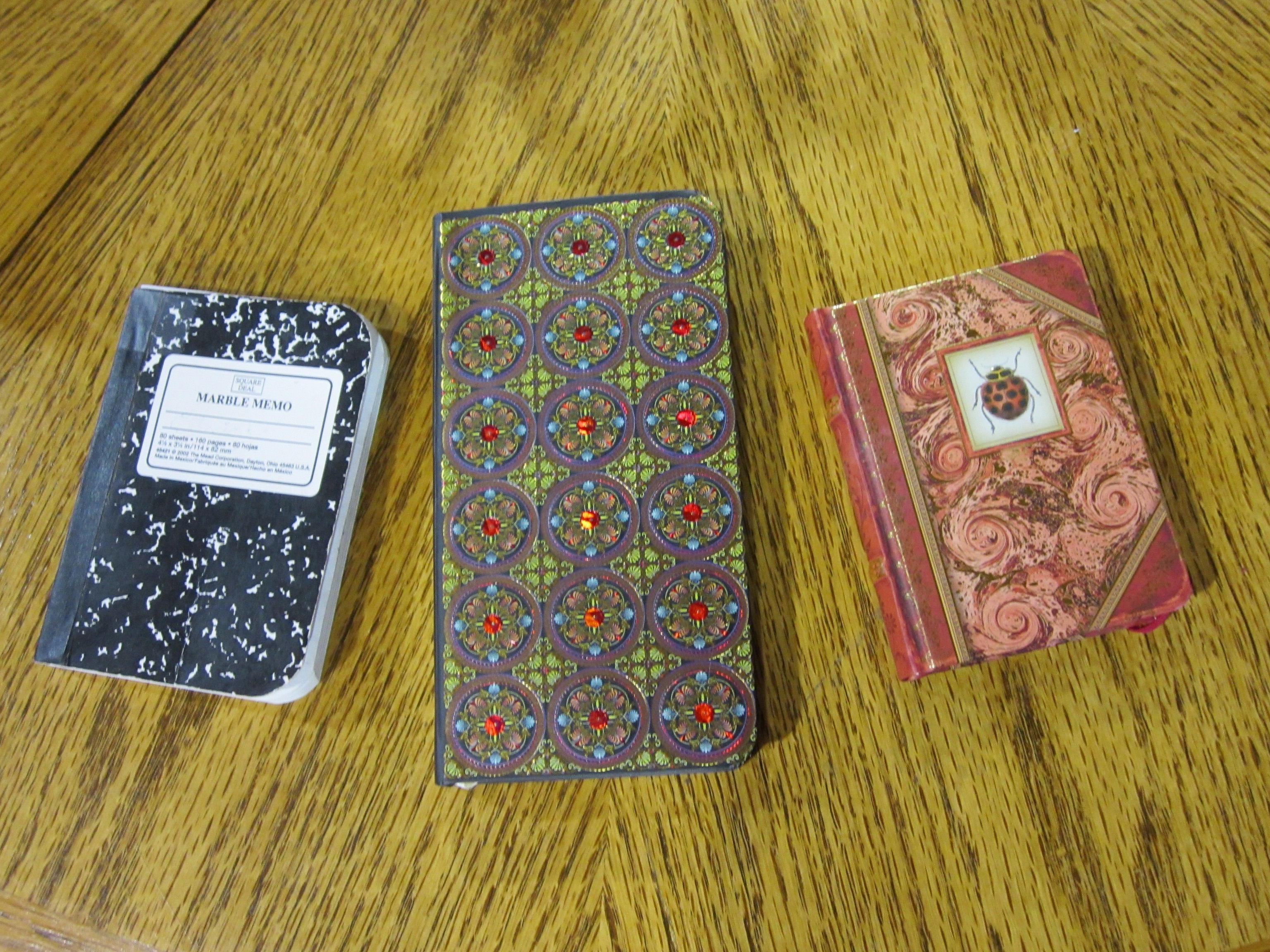
January 19, 2013Generally when I write I prefer the broad canvas of an 8 ½ by 11 inch unlined page. You can write, draw, or paste in photos or clippings. But I find the tiny, “mini journals” irresistibly attractive. While my regular journals are inclusive of all aspects of my life, these mini journals each represent a single microcosm.
The notebook with the marbled cover is a gratitude book. As a discipline, I tried to write one thing each day that I was grateful for or admired, one thing that brought joy into my life or that I thought was beautiful.
The red book with the ladybug on the cover has been the start of expressing one “haiku” thought on each page, an attempt to learn to say more with fewer words.
The gorgeous bejeweled book in the center is the book I chose to record the charming things said by my three year old granddaughter. I will do another book for the other granddaughter as she begins to talk.
These mini books are the purest joy to re-read because they filter out the negative. They sit on the table beside my bed. After a difficult day it is uplifting to remind myself of all that is good in my life.
I have started giving mini blank books as presents in the hope that others will be encouraged to use them for similar purposes. I do have other tiny notebooks I use to record things like houseplant and garden notes and the work I do in the bee yard. That notebook is covered in propolis (bee glue) and I must write with a pencil.
When purchasing these mini books, never buy one that has pages that are bound in with glue. Look for books that are sewn in or all of your pages will fall out over time. That goes for regular journal books, too.
It is interesting that many of the antique diaries I have seen, including my great-grandmother’s and great-great-grandmother’s, were so small that the space for each entry could hardly contain one sentence. Just one sentence can still convey a lot. If you don’t believe me, read haiku poetry.
Journal as Novel, Part II- Recording and Reflecting on Your Life Story
January 15, 2013Just read an interesting post from Bob Leckridge on his Word Press blog, “Heroes Not Zombies,” titled “Plots and Fate” :
Plots and Fate
January 13, 2013 by bobleckridge
“Each of us lives out a story, a dynamic narrative whose only consistency is that we somehow show up in each of the scenes. While the plots line may be unknown to us, there is one.” Creating a Life. James Hollis
“We know ourselves and others through the stories we tell. We create meaning and gain an understanding of the events and experiences of our lives by creating a narrative. And isn’t that quote so true? Doesn’t it sometimes seem as if the only constant in our life story is that we show up in each of the scenes. All of life, the world we live in and experience, is woven into these stories, which always, in some way, contain ourselves.”
I suggest you read the entire blog and see the connections with journaling. I looked up Creating a Life by James Hollis and that also seems an appropriate reference for those who are recording their life story in diaries. It appears to have received five star reviews on Goodreads.
The Journal as Novel
January 12, 2013Is a diarist a “writer”? Can we say we have written many “books”? (Don’t they look like books?) If life is story, then are you a novelist? Possibly a novelist of tedious prose, with far too many details, a novelist in need of an editor? When you have written about your life for nearly fifty years, as I have, it becomes a sort of opus perpetualis, a never-ending novel, although it will, of course, come to an end some day, and that’s called the denouement.
I enjoy reflecting on the similarities and differences between diaries and novels. The truth in a diary might be stranger than the fiction in a novel. The protagonist of the diary lives in the ongoing present moment yet possesses the ability to transgress time – relive the past and imagine the future. A future reader might know the last chapter of the story, even as the diary writer can look back in time and know the outcome of all the choices of his/her past.
Although a diary certainly lacks the cohesiveness of a novel, I agree with Patricia and Robert Malcolmson, editors of Nella Last in the 1950s, that “The unifying force in a diary is usually the mind of the diarist …”
All the elements of a novel are present in a diary:
The protagonist – complete with flaws (some tragic)
The main characters – family, friends, pets, allies or enemies
Minor characters – side-kicks, cameo appearances, angels and helpers, imaginary friends, antagonists and villains
Plots and subplots – challenges, entanglements, misunderstandings, conflicts, spicy sexual liaisons or tepid dalliances, insights and changes, and possibly the evolving of the protagonist
Settings – what an amazing variety in an average life!
Action and adventure
Depending on the unique tapestry of your writing you will either be a fascinating read in one hundred years or mundane and boring. Who knows? Who cares? I write my journal for myself and seldom think about how shallow it might be. I suppose I should care but I wish neither to entertain or enlighten anyone but myself.
My continuous novel looks like this:
Protagonist: me
Strengths: perseverance, mellow personality, even–tempered, honesty, reliability, courage, knowledge in certain areas, relative lack of prejudices
Flaws: indecisiveness, slowness to anger or take action, inability to play social politics, tendency to be too diplomatic, lack of energy
Weapons: the pen, determination
Stumbling blocks: often misjudged, seen as a threat, wrongly accused
Main characters: family, friends, pets, boyfriends, husbands, acquaintances, bookstore customers
Various settings: five states, cities and rural towns, a ranch, a farm, a cottage, bookstores, travels
Antagonists: sometimes those I love – family, friends, boyfriends; renters, technology, machines, weather, predators, Fate, Time, lack of money, cancer
Theme – good question
Plot – the protagonist attempts to:
1. make enough money to live on in a variety of jobs (day care, landscaping, pet sitting, bookdealer)
2. create a wonderful, community-oriented, thriving bookstore
3. love and support family
4. grow organic vegetables and beautiful gardens
5. maintain prosperous honeybees
6. live a totally conscious life with awareness of and respect for nature and the environment
7. participate in activities that will encourage community
8. create a National Diary Archive
That’s the outline of my never-ending novel, a best seller for sure. Comments? You may email me at bluemoon47@qwestoffice.net
National Diary Archive Update: January 2013
January 6, 2013The New Year has begun and I am returning to my work on the National Diary Archive which was interrupted by the intense labor of moving and then re-creating my used, out-of-print and rare bookstore, The Eclectic Reader, in Fort Collins, Colorado. In September of 2011 we moved 12,000 books and their bookcases and miscellaneous store furniture into a retail location close to home. It was an amazing transformation from a blank canvas to:”voila!” – a used bookstore. Although it took more than seven days, I am pleased.
You may visit The Eclectic Reader on Facebook.
So this will be the year of setting up the archive. If no one shows up to help, I will do it myself, “begin it now.” My philosophy on this is summed up in this quote cobbled together from various sources, (but definitely not Goethe):
“The moment one definitely commits oneself, then providence moves too. All sorts of things occur to help one that would never otherwise have occurred. A whole stream of events issues from the decisions, raising in one’s favor all manner of unforeseen incidents and meetings and material assistance which no man could have dreamed would have come his way. Whatever you can do or dream you can, begin it. Boldness has genius, power and magic in it. Begin it now.”
I am planning to have a website and a non-profit status by the end of 2013. I do not anticipate being so lucky as to have a physical building for the archive unless it’s free. Donations will be temporarily archived either in my garage (where the bookstore used to be) or within the current bookstore.
To start the year off with a bounce, I will be teaching a journal writing workshop on January 20th, from 1-3 p.m. here at The Eclectic Reader followed by a free social gathering for journal writers and a discussion on the creation of the National Diary Archive.
Contact Cynthia Manuel at The Eclectic Reader at 970-493-7933 or bluemoon47@qwestoffice.net
Britain’s Great Diary Project
March 24, 2012Hang your heads in shame, oh ye Americans! For, this time, Britain has won the race. They have now established an archive to preserve the diaries and journals of the common person. I know that this archive has been years in the making. Congratulations and sincere best wishes for our partner across the sea!
Their website is http://www.thegreatdiaryproject.com
It is my goal to maintain ties with their organization and share information. Since my ancestors were Brits prior to 1645 (messy little Revolutionary War aside) I am hoping to be allowed honorary membership in their group.
As described below, the creation of an archive requires these elements: “enthusiasm” and involvement from volunteers interested in the project, a physical location to house the archive, acquisition of diaries, non-profit status and financial support. It is my dream that someday we will have an archive in the US.
I will allow Catherine Robins to describe the formation of their archive in her own words:
The Great Diary Project Blog
Diaries are a valuable social and historical resource; they offer a window to past lives of a huge spectrum of people, building an image of their lives and the developments which fed today’s society. At the moment these too often meet a wasteful end.
The Great Diary Project aims to stop this by establishing a Diary Repository which will house and make available these valuable commodities.
To do this requires a mix of 1. Enthusiasm for the cause from those involved 2. Finding a home for collected diaries 3. Diary collection and 4. Raising public awareness.
My role is to use social media in order to achieve 4. and so encourage 1. 2 and 3. This blog therefore aims to captivate your enthusiasm through a personal account of the project and so urge you to take a look at our website (link), like us on face book (link) and follow us on twitter (link) and generally spread the word.
First, a disclaimer: This blog tells the story of the project from an entirely personal perspective; were you to speak to others from the project, you would likely find a whole multitude more of opinions and experiences. This is partly because I could not find the words or space to properly articulate each persons story. But also because I believe in the cliché ‘passion inspires passion’; a personal story allows for proper communication of my belief in and experiences of the project.
Herein follows my story of the Great Diary Project.
October 2009; I am inevitably running late for a final year University class. This doesn’t stop me pausing to listen to a radio interview, then manically googling to find who the speaker was (otherwise known as internet stalking a radio interviewee). The reason being that the topic was diaries, and one of the one of the interviewees (Irving Finkel) was exhorting the need for a national Diary Repository to save this fantastic piece of history.
This ideal resonated absolutely with both my scholarly and personal experiences*;
At the time I was working on my dissertation and essentially it would have been a whole lot easier had I been able to read a few contemporary accounts which told me exactly what people at the time thought. I have also kept diaries since childhood and have wondered of the conclusions which might be drawn about myself and my contemporaries were these found in years to come.
I was hooked. I emailed Irving immediately – probably some nonsense along the lines of ‘wow this is so awesome I totally agree thanks for being on the radio, great, thanks.’- and fortunately for me he replied. Thus I was involved.
Soon after Irving came and delivered a seminar and a lecture on the topic of diaries at the University of Leeds. With him Irving brought a selection of his favourite pieces; a diary, for instance, from a train spotter who every day logged the trains he saw, until one day entries abruptly stopped. One can only imagine. A mixed crowd of students, lecturers and friends were enthralled; no one left, even when the refreshments ran out and afterwards people crowded round to ask questions and congratulate the cause.
At a later date I met with Irving in the primary diary store – his office. It was wall to wall, ceiling to floor and every other cliché in between which indicates the room was bursting at the seams with books. It was an amazing sight, but clearly not a viable long term solution.
Between this point and now others have done fantastic and dedicated work. Diaries continued to be collected, a cataloguing system was begun, diaries inputted to this during lunch hours and at home, and a home for the collection continued to be sought for.
Now we are pulling together even more to really push the Great Diary Project into the public consciousness. And for this to work we need you. So I reiterate; we need you to tell other people, like us on face book, re post our posts, follow us on twitter and re tweet our tweets.
And please do visit out website for more information www.thegreatdiaryproject.com
All that remains for me to say is thanks for reading and thank you to Cynthia for very kindly affording us a space on her blog.
—————————————————————————————————————————-
* Referring to the work contributing to a History BA as scholarly may be a tad much but it does make for a nice turn of phrase
Party of One by Anneli Rufus – Book Review
March 17, 2012
If you consider yourself a “loner,” and I suspect that many of us diarists fall into this category, then I am going to recommend a book that will help you hold your head up proud and banish to the dung heap all those taunts of anti-social behavior. It’s called Party of One: The Loners’ Manifesto, by Anneli Rufus.
The cover of the book is hilarious – a sheep, standing all by itself on a hillside. The book is described as “an essential defense of the people the world loves to revile—yet without whom it would be lost. “ “Self-reliant, each loner swims alone through a social world—a world of teams, troops and groups—that scorns and misunderstands those who stand apart. Everywhere from newspapers to playgrounds, loners are accused of being crazy, cold, stuck-up, standoffish, selfish, sad, bad, secretive and lonely—and, of course, serial killers. Loners, however, know better than anyone how to entertain themselves—and how to contemplate and create. They have a knack for imagination, concentration, inner discipline, and invention—a talent for not being bored.”
Loners, you will love this book. It is definitely witty. And lyrical. I see someone else called the writer “provocative and passionate.” I enjoyed her writing immensely and not just because she was giving the old one-two to negative images of the loner.
A few quotes from the book:
“Because we do not feel as one with others or equate ourselves with others, we suspect whatever is popular. I am not the only loner who puts off seeing top-ten movies or reading top-ten books.”
“There is simply too much to do alone, no time to spare. Shared time, while not entirely wasted if the sharer is a true friend, must be parceled out with care, like rationed flour.”
“Spending a lot of time alone is like an accidental meditation. A casual mindfulness. We do not have to work at this, at observation or serenity. Any loner is halfway to Buddhism without knowing it.”
“We do not require company. The opposite: in varying degrees, it bores us, drains us, makes our eyes glaze over.”
Our loner view of insanity would be: “That talking to others all day is symptomatic of failure to individuate. That it indicates an unhealthy fear of thinking.”
Rufus writes chapters on the loner and popular culture, friendship, film, advertising, religion, crime, literature, childhood, eccentricity, and more. She is sharp and perceptive.
At my recent gathering of journal writers we discussed the accusation that one of us spent too much time writing about life and not being with other people. From a loner’s perspective I would ask “Do we need to spend time with other people?” (Just kidding.) From the smidgen of non-loner in my personality I would say “What you need is balance.” For a loner that balance might be 75%/25%…75 for you, 25 for social contact. We must have some connection. We all need some. (“All we need is love.”) We may not need as much as the non-loner. We tend to be more sensitive to things like the noise and confusion of a party and to be better at observing others and getting in touch with our own feelings and thoughts. We are not necessarily bad conversationalists but we do make mighty fine writers.
I spend my days talking to people now. Sometimes talking with them and having great conversations. I am good at that. But when the clock says closing time I flee to my private sanctuary on my farm. I spend my home-alone time with my cats. They understand. They have spent the day being loners and when I come back they want to hang out as a tribe. But they are quiet. They enjoy watching me read and write, often helping by holding down the pages.
When I write in my journal in the mornings I am actually meditating. I am meditating about all that I have seen and heard and felt during the day. I am examining the strange things others do that puzzle and frustrate me. I am trying to understand life because it is complex and it is not easy. I am leaving a bread- crumb path for others to follow.
 National Diary Archive