Lifeprints – Joannah Merriman

March 12, 2012

I suspect there are many other ” local” Northern Colorado people who are involved in promoting the creative discipline of journal writing.  I am certain that each has a special niche within this field.  It may be using art to illustrate your journal.  It may be a focus on writing memoir, or coaching, or leading workshops and retreats on reflective writing.

By the way, anyone across the country is welcome to contact me with information on your workshop and I will mention it in this blog.

In my own backyard (Fort Collins, Colorado) we are privileged to have Joannah Merriman, who established “Lifeprints”  in 1985 to promote reflective writing and has continued to expand and develop her foundation since then.  There are many types of workshops available.   One of the awesome opportunities offered through Lifeprints is the chance to go on a women’s journal writing retreat and guided tour of France or Italy.  This year they will be traveling to Provence and Paris, France from May 4 to 20.

For more information about Joannah and Lifeprints go to her website at http://www.lifeprintsjournal.com


A Gathering for Journal Writers

March 12, 2012

On January 15, at my bookstore’s new retail location, I held a gathering for journal writers.   To my dismay only two people showed up, although it was advertised through the local paper, flyers, at the store itself,  and on Craig’s list.   I am not sure what this tells me.  There are so many ways to look at this.  The bookstore is still unknown and perhaps I need to establish more social-political ties through networking.

All three of us at the gathering were long-time journal writers: two older women and a man in his thirties.  He had some concerns stemming from criticism that he writes too much.  He works as a teacher.   We talked about balance.  I often observe that non-writers— especially people who do not keep journals— feel there is something harmful about recording your thoughts, feelings and experiences in a book, something loner-ish, as though you are a social misfit.   Au contraire, I think this is a path toward mental health and a form of meditation that deepens your life…particularly when continued over a long time.

Another issue we discussed was whether a diary archive should insist that all donations of diaries, journals and letters should be immediately open to the public or whether a donor could choose to keep them closed for a certain period of time to protect the people written about.   My position is they should be allowed to be closed for whatever amount of time the donor wishes.  There was some disagreement over this issue.

I hope to try another gathering for journal writers this coming year.  The question is whether there are many journal writers anymore and if these are individuals who enjoy socializing or those who prefer keeping their thoughts private.   I personally love groups and conversation.  More on “loners” in a future blog…

Look for future gatherings and check out my bookstore: The Eclectic Reader on Facebook.  Email at nationaldiaryarchive@qwestoffice.net


Nella Last’s War – Review of Published Diary

February 24, 2012

Nella Last’s War – Book Review of Published Diary

In 1937, Britain initiated an exceptional project: The “Mass-Observation.”  It was created by Charles Madge, poet and journalist, and Tom Harrisson, anthropologist.   The purpose was to “record the voice of the people.”  Volunteers were asked to keep a Mass-Observation Diary.  Nella Last became one of the 500 people who chose to participate.  Her diary was outstanding for its quality of writing and depth.

This archive at the University of Sussex Library is proof of the value of journals written by ordinary people — exactly the archive I have envisioned for the US.  Furthermore, they are sponsoring an ambitious  project that has been going on since 1981 where hundreds of  volunteers write in diaries and produce autobiographical material that will be included in this archive for research and teaching.

Nella Last’s War gives an intimate look at what it was like for a middle-aged woman and mother of two sons in the war to live through World War II.  The writing is exceptionally good.  Like most diaries, it is an “interweaving of her day-to-day life, inner thoughts, general observation and descriptions of contemporary life…”   I admired her spunk and real inner strength in spite of her admission that she did not always feel inside what people saw on the exterior.  I saw the beginnings of feminist thinking in her reactions to men.  She was quite harsh on her husband.  It appears she was the backbone of her marriage.  I doubt he could have survived the war without her.  Rightfully so, Nella railed against put-downs of women as silly and weak.

The supporting role of the citizens of England in the war is an extraordinary sub-plot of World War II.   Nella Last’s ability to survive deprivations and tragedies, get by on less, and cling ferociously to what is good in life, was inspiring.  Her dedication to doing something for the war effort and rallying others to do the same kept her from the depression that destroyed some.

Yet do not think she was an ardent supporter of the war.    Her occasional political remarks revealed much criticism.  Her expressions of feeling about the devastation of War, human and otherwise, the unfathomable waste of it all, were poignant in the face of the endlessness of War that we can see from the perspective of the future.  How many wars have been fought since World War II.

I encourage all of you serious diarists to read published diaries from time to time.  Although you should not compare your journals to an edited one that has been published it will still give you much food for thought.  What is it about the diary you are reading that gives it meaning?  What are the details that you find fascinating and what comes across as a bore?  (Or do you suspect the editor removed all of those repetitions and silly and obsessive little details that most of us feel compelled to write…like the weather or when we got up or went to bed or what flowers are in bloom, etc. )    Does the diarist record great insights?  (Yes, usually.)  What seems to be missing?  And how does all of this compare to your own journals?  Are you motivated to change the style of your writing?

Reading someone else’s work inevitably leads me to reflect on the dual nature of our personalities – our public face and our private one.  There is so much more going on inside each of us than we are ever able to reveal and yet remain socially viable.   I think about this whenever I record an event in my journal and know that if I were to write an article about that same event for publication in a newspaper how much obfuscation of the truth would be necessary.  That’s why I love writing in my journal.  I can tell the whole truth…as I see it.

I have already ordered the second volume of Nella Last’s diary.  Copies  of Nella Last’s diaries may be ordered on Bookfinder.com

A Speaking Engagement for the National Diary Archive

February 18, 2012

A Speaking Engagement for the National Diary Archive

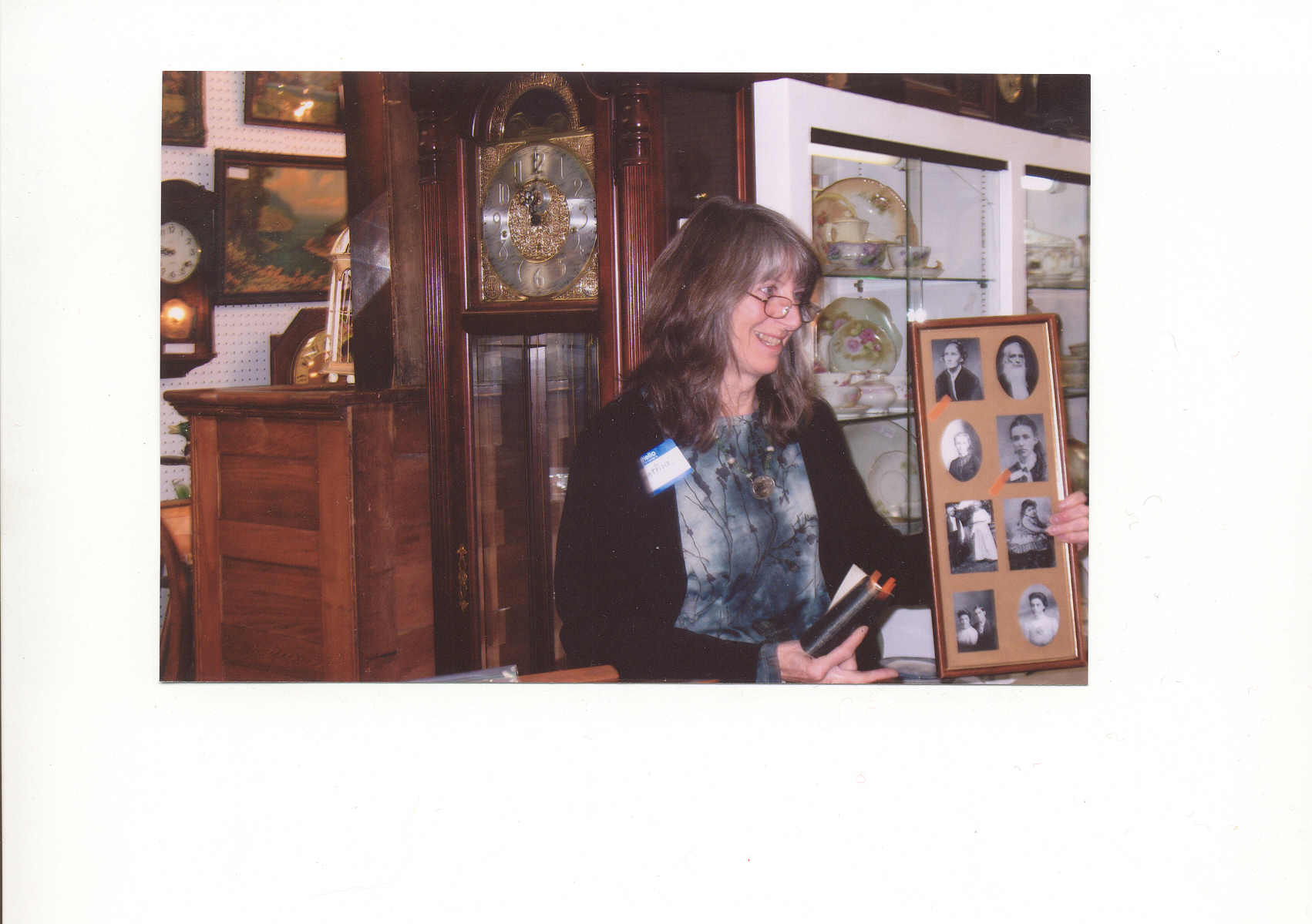
On October 10, 2011 I gave a presentation before the “Auntie Stone Questers” of Fort Collins  about the National Diary Archive project.  There were about a dozen women present.  The focus of their group is on the history, collection and preservation of antiques.   They are also involved in the preservation of historic structures.  Each month a  guest speaker is invited to lecture on a particular specialty within this almost unlimited field.

I began my talk with my own 47 year background in journal writing, then a little about my mother’s, great-grandmother’s, and great-great-grandmother’s diaries, ending with my current interest in establishing an archive.  I illustrated what can be learned from studying old diaries by reading from a few I brought with me.   I talked about some famous diarists and published diaries.   My lecture emphasized why I believe old diaries should be preserved in an archive.

I gave this presentation in a local antiques flea market. Afterward I asked the owners if they had any diaries for sale.  Interestingly, they said that in all the years they had been buying antiques they had never run across ANY journals.  All they had was some sort of accounting book from a store.

Several of the women in the group brought family heirloom diaries and ephemera.  We discussed where you might find old diaries…eBay, if nothing else.

I also mentioned the value of saving old letters, a subject I have not yet covered on this blog.  Letters, I think, are more common in a family’s hand-me-down treasures.   Keeping a journal requires ongoing dedication to a sometimes difficult task, a commitment many cannot make.  Now that we are in an age where letter writing is nearly extinct, it is all the more important to save those old letters we find.

Interview With Sally Macnamara, Collector of Handwritten Diaries

January 12, 2012

Not long ago I started corresponding with Sally Macnamara Ivey who has collected and sold diaries since about 1987. She accepted my invitation to be interviewed for the National Diary Archive blog.

I found some of her answers to be very moving.  She expresses beautifully exactly what I feel about the importance of preserving old diaries.  I especially agree with her comments that real life is more exciting and rewarding than fiction and that everyone has a story to tell and something to offer.

Her website is:  http://www.sallysdiaries.wordpress.com  and email: macnamara@wbcable.net.  Her eBay seller name is “diaries.”

Here is the interview:

First of all, are you a diarist and, if so, for how long?  What form of diary/journal do you keep?  (Notebook, bound book, large or small pages.)

I started my first diary at the age of 10. Most of those entries were one liner’s like “went to school” or “went to choir” etc. Later on through my high school years my diary entries became much longer and I wrote on every available space the page would allow. I am now 55 years old and have kept a diary for many of the years of my life. I would say I have over 50 diaries but have never counted them as they are all over my house in trunks, on shelves, in drawers, etc. As far as what form of diary I keep it’s really a variety of different types of journals; notebooks, 5 year diaries and sometimes just loose pieces of paper. I must say a beautiful cover really draws me in and I have several blank journals that I purchased because I couldn’t pass them up (because of their beauty) and they are just waiting to be filled.

If you keep a diary, what are your plans for it after you die?

I have four children (the two younger ones are step children although I consider them my own). Bret is 30, Cass is 28, Reese is 27 and Kera is 25. Although all of the children are so precious to me, my diaries will go to my two biological children because most of my personal diaries have to do with my life before I married my second husband Kevin. I believe Cass is the one who knows her moms deepest thoughts and because she is also keeping a diary, I feel she would cherish and understand them the most.


What would you say is the purpose of your writing?

I’ve always had this deep desire and need to write down my thoughts and a few years back I had an epiphany about my journaling. I seem to write more often during my times of difficulty and sorrow. Sadly my life has been very difficult since I was a little girl and without getting too deep (and too long winded) my childhood was that of neglect (putting it lightly). Then my 1st marriage, which was to a rock musician, was that of unfaithfulness on his part, then my divorce from that 14 year marriage, the recovery and finally my 2nd marriage to Kevin, who in my eyes was the most amazing man in the world. Then his tragic sudden death 3 years ago. I have diaries for most of the years in my life except the 14 years I was married to Kevin; my happy and content years. These last 3 years, because of his death, I’ve done more writing in a diary then ever before in my life.


What subjects do you write about?

My subjects are about anything and everything but mostly my deepest feelings. I also love writing about my travels, my precious children, daily events, etc. But mostly my thoughts and feelings.

Do you include anything other than writing in your journals?

Very little although that’s one of my favorite things to find when collecting other peoples diaries. When I find bits of ephemera (such as photos, tickets stubs, drawings, letters, notes, etc.) between the pages, it is such an added bonus when reading the authors story. I’ve never done that and I don’t know why but I think it’s because I’m so busing writing that I forget. However that leads me to your next question…

Has anyone else in your family kept a diary?

My daughter Cass keeps a diary and the pages of her diaries are stuffed with all kinds of ephemera and drawings. She’s also a big traveler and she’ll put mementoes of her trips inside her diaries representing all the places she’s been. In fact when my husband died she gathered leaves from the trees and also from many of the flower bouquets we got and pressed them for me. I have pressed flowers all over the house now. I do however have several drawers full of ephemera that I am keeping that I one day hope to put in my diaries; don’t know why I haven’t done it yet. An interesting thing for me to ponder.

What made you want to start collecting other people’s diaries? Did you begin with the idea that you wanted to sell them or did that happen later as you acquired a large collection?

When I was little my mother use to take me “dump diving” or so I called it. I found an old paper check stub and was amazed that it lasted as long as it did. We would also sneak into old abandon houses, or rather she would mostly, and she would tell me the stories of what she found. I was so amazed. Her stories staid with me and coupled with the fact that I wrote in my own diary, I guess one day I thought why wouldn’t old antique diaries survive. That began my interest in searching for and eventually finding “other people’s diaries.” EBay really got me going too because it opened up a whole world, literally, of diaries and they were right at my finger tips.

Are the diaries you have collected historic? Which ones are most interesting and why? And do these diaries go into depth of either emotion or experience? Describe a favorite selection from one of the diaries.

Here’s the part I could go on and on about. Many of the diaries (and letters as I collect handwritten manuscripts too) in my collection are historic but I never purchased them for that reason. When I buy a diary I can usually tell with the first few minutes if it’s going to stay in my collection or if I’m going to sell it. The actual feel of the journal itself, the emotion and depth of the writing, sometimes the amount of writing but not always and sometimes the subject are key factors in my collecting. Date doesn’t really matter as I have diaries from the early 1800’s and as late as the 1970’s. I also have a particular passion for shipping, (as in the sea) diaries.  The 1st one in my collection that comes to mind as far as historic or interesting was written by a young immigrant girl named Olga whose parents didn’t have enough money to raise her and so when she was in her late teens she was placed in a home for “wayward girls” run by a very strict religious group. The diary starts out in the early 1900’s and opens up with Olga’s best friend laying in her lap dying. The friend has taken poison in an attempt to kill herself and sadly she does die. Olga’s entries are so deep and she holds nothing back. It really reads like a movie script. I also have an amazing diary from a young lady who attends the 1893 Chicago World’s Fair Exposition and it’s full of drawings, ephemera and detailed accounts of her trip. And possibly my most historical diary was written by George Eaton who in 1912 was with Hiram Bingham discovering and uncoveringMachu Picchu inPeru. The diary is from that discovery. Then there’s the 2,000+ handwritten letters (and photos) I have from one family that read like a diary. They represent the years spanning 1870-1940 and they are from anOregon family who owned a stage coach line and also telegraph company. I could go on and on and as you can see I’m obsessed with my collection and other people’s diaries. I would say I have over 250 diaries (maybe more) not counting letter collections.

How do you feel when you read someone else’s innermost thoughts? Was that part of the attraction of reading diaries? How have you benefited from knowing the truth of someone else’s life? What have you learned?

First of all I have the highest respect for any and all of the authors I have ever read or will read when it comes to their entries. And what have I learned? Oh my goodness. The most important thing I would say is that real life is so much more exciting and rewarding to read about then any story anyone could make up. And that, no matter who you are, every life, every true story, has fascinating aspects to it and that we all have a story to tell. So many people think they have nothing to share, nothing to teach, nothing that’s worthwhile in their life but that is so untrue. After reading thousands of other people’s diaries, honestly all of them are amazing in their own right.

How do you feel about dividing up all the diaries written by someone over many years? What is your position on that and why?

I hate it. I know that’s a strong word but it just breaks my heart to see a persons life, a person who spent years and years writing down their most cherished thoughts, and then having those manuscripts being split up for monetary reasons. And I say monetary because I can think of no other reason for this to even happen. I go broke trying to keep lots together too. My main goal for selling diaries is not for the money (although it does help of course so I can buy more for my collection) but the reason I sell and share them is so people can feel the way I do when they read them. I could share so many instances where the diaries I sell have gone to wonderful homes and many times even back to the original families. In fact I want to share an email here from a college I’ve sold to for several years now, and I quote….. “We’ve had an incredibly busy fall with classes coming to use our collections, often for assignments. When I first came to the college, we had six class sessions in the fall semester. This fall, we’ve had sixty-seven and a few more still to come, with more than 1,500 students. We’re getting so well-known on campus that faculty come to us now rather than us having to go beg them to come. So the stuff you’ve sold us is getting lots of use!”

I just love knowing that the students and faculty in this college are able to use the diaries I’ve sold as a form of study and I can’t imagine giving them just “part” of the story to study with. When you split up diary lots its like taking a limb from your body, taking a memory out of your mind, the story is broken and historically and ethically it is so wrong to me.

How do you find diaries?

EBay is my main source of diaries now although there seem to be less and less of them out there. I also find them at antique shows and fairs, paper shows, estate sales (rarely) and also have people who know I collect them and occasionally they come to me with one.

Why do you think we should attempt to save the diaries/journals written by the common person?

The internet has taken over the way we live. Not as many people write in journals anymore and “deleting” our thoughts is so easy and they are forever lost. To hold a handwritten diary in your hand, to be able to preserve it for future generations, to experience someone else’s life through their own writing, is so very important in this day where books, paper and the pen are becoming extinct. Reading other peoples diaries, to me, is the closest thing you can get to time travel. Sounds a little goofy I know but believe me, after reading all the diaries I have read in the last 25 years, all of them have taken me back to a place where I long to be. People I would have loved to have met and visited with, traveled with, cried with, laughed with. Diaries allow me to do that. Diaries are who we were, who we are and who we will become hopefully never to be “deleted.”
Anais Nin: A Legend of Journal Writing

September 6, 2011

Passionate, intense, emotional, deep, lyrical, magical,  intuitive, highly perceptive of the subtleties of human behavior, deceptive, sensuous, exotic, erotic…these are all adjectives I would use to describe the writings of Anais Nin, queen of the diary.  There are so many complexities to her life that Anais Nin will remain forever a tantalizing mystery to her biographers, as I suspect she was during her life to her friends and lovers.  One of her favorite words was “labyrinth.”  Nin was a labyrinth! I have read that no one is lukewarm about Nin or her writings.  You either love her or hate her.  Put me on the side of love.

In 1971, in a dusty used bookstore in Point Reyes Station, California, I reached for a slim volume of prose: Under a Glass Bell.  In that moment I connected with the woman who was to become a major influence in the way I thought about women writers and the diary.   At the time, I scarcely knew there were women writers, and I had been keeping my own diary only eight years.

Under A Glass Bell (published in 1944) was an astonishing discovery for me.  Even in 1971, women writers were rarely acknowledged and their work and their way of seeing the world was dismissed as frivolous, rarely admitted as serious literature.  I know because I was an English lit major and we read only male writers.  In a college course in 1968, my textbook of 100 poets had only one woman poet, and that was, of course, Emily Dickinson.

As for keeping a diary, such writing was considered of little merit, particularly if you were a woman, were not a famous artist or writer, and were not involved in a historic event.  Until the early seventies, and the dawn of the Women’s Movement and the promotion of women’s writing, I don’t believe diaries were  even considered a “genre” of writing.

It is still a struggle to find acceptance for this style of writing.  Keeping a diary is frequently believed to be more of a self-indulgence than a serious attempt to deepen life and expand the boundaries of experience.    Just try saying, if you are among a group of writers and are asked what you write,   “I am a diarist,” without being met with a dismissive indifference or superiority.

Anais Nin liberated my thinking.  I soon found her diaries and began devouring them.  I was in my early twenties and I wanted to be Nin. (My own diaries began changing – deeper, more explicit. )  I was most impressed with her analysis of people and relationships and the way she described the nuances of interaction and the layers of meaning in experiences.    Next I read her continuous novel: Cities of the Interior.  In my 40s I returned to Nin and read her pornography, and then Henry and June, the unexpurgated version, (made into a very erotic movie  with look-alike Maria de Medeiros.) Last of all, I read her thought-provoking essays and lectures (she was a popular speaker on college campuses).

I deeply regret that I was never able to meet her.  (I do have an inscribed copy of Cities of the Interior.)  Recently I listened to a tape of an interview she did in 1971 with Studs Terkel.  What a beautiful voice.  There are many interviews available on the internet.

For those already familiar with Nin, I have found A Cafe in Space: The Anais Nin Literary Journal, online.  I think most of her books are available as ebooks as well as real books.

There are websites devoted to Anais Nin quotes.  As a collector of quotes over many years, here are some favorites:

“We write to taste life twice, in the moment and in retrospect.”

“Each friend represents a world in us, a world possibly not born until they arrive, and it is only by this meeting that a new world is born.”

“There is not one big cosmic meaning for all, there is only the meaning we each give to our life, an individual meaning, an individual plot, like an individual novel, a book for each person.”

“…Beware…love never dies of a natural death.  It dies because we do not know how to replenish its source, it dies of blindness and errors and betrayals.  It dies of illness and wounds, it dies of weariness, of witherings, of tarnishings, but never a natural death.  Every lover could be brought to trial as the murderer of his own love.”

“War is the great pleasure of people whose love is atrophied, who need war to feel alive, who find in violence and clash a semblance of relationship.  Relationship by hatred.”

So, here is my second favorite published diarist, and if you have never experienced her writings before then you are missing a truly unique writer who can transport you to the “cities of the interior.”

The Name’s the Thing

August 14, 2011

I have been asked recently about the name of the diary archive.  Since it does not officially exist I can still change the name.

There is disagreement and confusion over whether ” journal” or “diary” is more accurate or inclusive.  I like to call my books “journals” as they are not merely records of daily activities, but this archive would be for all forms of self-recording, from journals to diaries to travel logs to letters.  We might include taped diaries – say those on cassette or reel to reel tapes.   I have quite a bit of all these various forms from my own family…going back over 100 years.

One of my readers keeps transposing letters – diary to dairy.  I admit I do the same.  Still, I think a “diary” archive sounds best.  I am loathe to name it for my unsupportive city.  Besides, to think we might some day have more than one archive is too much to hope for.

An alternative name is the “Anam Cara Diary Archive.”  (Pronounced Ah num car uh.) I stole this idea from a John O’ Donohue  interview.  He wrote a book by this title.  In Gaelic your “anam cara” is your soul friend, someone to whom you confess.  This sounds to me like the perfect name for a diary archive, yet who knows Gaelic?

A while back I thought I read that a non-profit could not be called “national.”  That may not be true.

In any case, the archive really has no name yet, but I strongly support having “diary archive” in the title.  I am open to all suggestions and will settle on a name when it becomes a non-profit.


A Somewhat Personal Update

August 14, 2011

Earlier this week I wrote: I am sitting on a bench in my private space under the arching branches of the New Mexican elder.    On either side of me – a cat.  One, my own Maine Coon giant, and the other, my neighbor’s cat who has decided he wants to live here in this cat and wildlife sanctuary.  I am almost hidden by the blue salvia, which is joyously alive with honeybees and butterflies.  To the north I see the fading yellow blooms of the goldenraintree which stands as a sentinel before the jungle of the creek area.  The east is dominated by my neighbor’s towering cottonwood rustling in the slight breeze.  To the south I can hear the invasive cacophony of traffic.  Behind me to the west, the chickens are purring.  It is in the 90s.  I am in the shade.  All around me I hear bird song and thunder.  The storm is going to miss us.  Today I have been pondering the mysteries of life and death, as diarists enjoy doing.  I have been pondering my own uncertain future.  How much time do I have? What can be done?  Am I totally nuts to open a bookstore again in this age where “the book” is dying?  And more to the purpose of this blog: how can I use the bookstore to advance the National Diary Archive?

In March I began 33 days of radiation therapy for a liposarcoma.  By May I was jumping right into work on the farm: collecting bee swarms, growing a huge garden, mowing lawns, watering, weeding, overseeing the help that I had to have this past year.  The entire farm is being painted this summer…a red barn at last!  Not to mention all the preliminary negotiations on opening a bookstore.  Have I given up on the archive? No.  Just put it aside for a while.

Here is the current plan:  I am soon to be moving my in-home bookstore of 12,000 books to an actual retail location.  As soon as it is open I will begin regular journal workshops.  I am considering paying a lawyer $750 to create a non-profit organization.  I will search for a volunteer staff and archivists.  I will then solicit donations and attempt to build this organization.  “If you build it they will come.”


What You Can Do to Support a National Diary Archive

April 6, 2011

“What can those of us near you in heart but not geographically do to help?”

One of my readers asked this question and I will try to answer it, based on where the archive is now in its formation progress.

First of all, tell your friends about it, especially those who keep diaries.    You never know what connections might be made. If you teach journal writing, inform your students that there may soon be an archive.  If you keep an on-line diary you could ” blog” about the archive.  Everyone who keeps a journal should think about what will eventually become of them.

Assuming you are a diarist, stipulate in your will that you would like your diaries/journals to be donated to an archive upon your death and include at what point they may be open to the public.   If you wish to protect friends and family who are still living from reading what you truly felt about them, then consider stating how many years the diaries should remain closed.  You might allow staff of the archive to prepare them by transcribing them or digitizing.   You may want them to be available only to those visiting the actual location of the archive and for research purposes.   When an archive is opened in the United States, you could specify that archive in your will.

If you keep a diary/journal, give some thought to organizing and preserving it.  (See my post on that subject: “Now Where Did I Put That?”)  At the very least, put your name in each volume and where it was written.  If possible, create an index for each volume, each year, and the sum total of your work.   This will also make it easier for you to go back and re-read, which is an important benefit of this genre… an opportunity for self-insight and depth.

For all who would like to see a national diary archive I would recommend collecting diaries.  It is an expensive hobby so you might think of asking for “handwritten diaries” as presents, as I did.    Becoming the caretaker and  conservationist of someone else’s work gives you a sense of the importance of your own writing.   It might also show you how to improve your own writing.

If you begin your own collection of handwritten diaries you could transcribe them and put them online, or allow an archive to put them online.  The actual diaries could be kept by you and donated upon your death.

If you live near this archive of the future (Fort Collins, Colorado?) you are more than welcome to volunteer your time.

And, if none of the above works for you, you could always donate money.  So, keep watching our progress.

Progress on National Diary Archive

April 2, 2011

No blogs for some time and not even a single entry in my private journal!  Life has grabbed me by the throat and not let go since my last post.  But there is progress to report:

After my first rejection by the Fort Collins Public Library, I decided to try again.  I was attempting to reserve a room at the library for a free in-depth journal workshop followed by a presentation on the National Diary Archive.  I was told that only non-profit organizations or programs supporting the general purpose of the library could use the rooms.  It seemed to me that journal writing and a diary archive fit that description.  (The archive has not yet become a legal non-profit, although that is the intention.)

On my second try I gently complained that the last two lectures I attended at the library appeared to be by private citizens making a profit on their event.   One was a talk by a local author.  A local bookstore was clearly making money selling her books at a table in the back.  The second lecture was about blogging.  The blogger would not answer my question, instead she handed me her business card and said she was available for consulting for a fee.

I walked a fine line in presenting my case.    I could feel that I was close to stepping on toes but the initial resistance at the front desk gave way and I made it to the next level, and from there, on to the top administrator, who actually was interested, even excited, by the idea of an archive.

So, on April 10th I will be giving my first presentation in Fort Collins, Colorado.

Although my city is proud of being consistently named one of the top ten cities in America, I remember the days when it would not suffer a coffee shop to live. The attitude was that a coffee house was a place akin to an opium den.  We’ve come a long way, baby, as now there’s a coffee house or petit drive-through dispensary on every corner…and for other things as well.

Since 1983, Fort Collins has killed 14 used or new bookstores, including mine. And although the main newspaper has no interest in a story about the archive, nor the higher quality “local news” paper which specializes in human interest stories, I still have a modicum of hope that this idea might someday thrive here.   Perfect climate, low threat of natural disaster, easy access, and situated in the heart of the country.

Truly, I haven’t tapped but the surface of the possibilities here.  The support may need to be on the national level but the team for the non-profit needs to be local.  Already I have found someone who has taught journal writing for many years.  I am searching for others wishing to get involved.